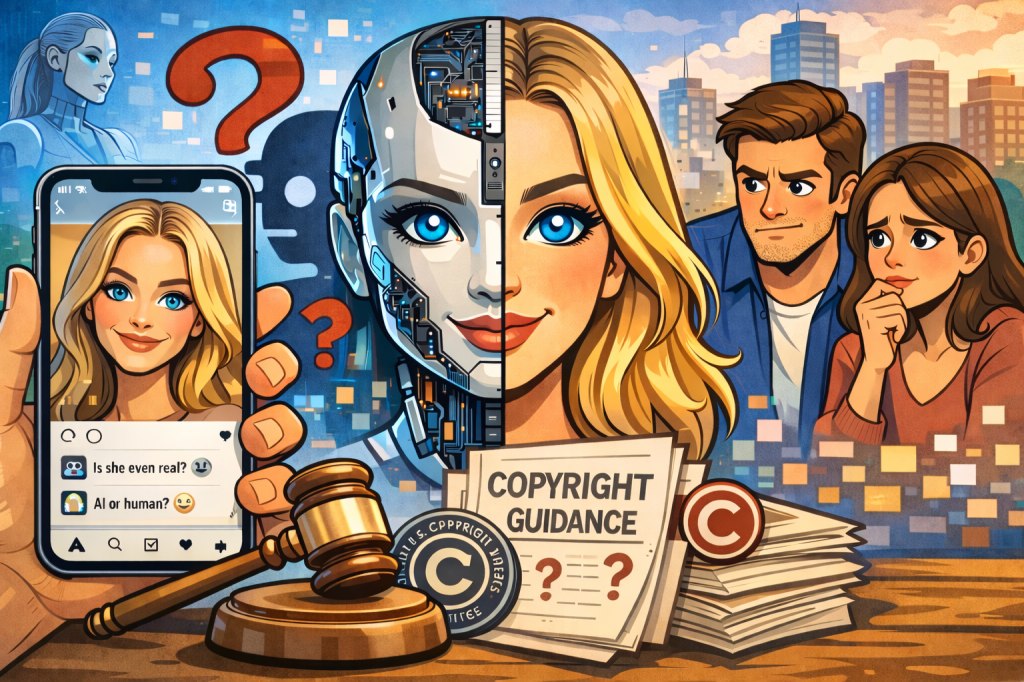
Debates as to whether the newest Instagram model has botox is that of a bygone era. Now, social media consumers skeptically view Instagram posts questioning whether it’s a real human or just AI (Artificial Intelligence). Beyond photographs, even video content has been increasingly infiltrated by generative slop. With the surge in AI use and popularity for content creation, what rights do content creators have over their AI creations?
For starters, the main consideration for AI produced works is whether or not the creator (i.e. the person who imputed prompts) has a copyright claim over the generated output. This is a complicated question with a variety of answers depending on the specific facts of the case. The Supreme Court established in Community for Creative Non-Violence v. Reid (“CCNV”) that “the author [of a copyrighted work] is . . . the person who translates an idea into a fixed, tangible expression entitled to copyright protection.” This means that a non-human, such as AI or a monkey cannot have copyright protection over their creations. So, with “human authorship as a bedrock requirement of copyright,” does this mean no AI-generated output can be protected? The good news is no! The Copyright Office has clarified that “the use of a machine as a tool does not negate copyright protection” (Page 9). Rather, works created by way of AI-generated output can be protected when there is human involvement– known as the human authorship requirement.
How much human involvement? Well, it must contain “sufficient human-authored expressive elements” (Page 9). To understand exactly what sufficient human authorship entails, the Copyright Office provides guidance through the famous joint authorship case CCNV. The case centers on a non-profit organization that conceived an idea and the artist they hired who sketched, designed, and executed the creative vision into a tangible medium of expression (the golden words of copyright – meaning putting an idea into physical form which is one of the base requirements for copyright protection). The DC Circuit Court, on remand, determined that commissioning the sculpture and providing detailed suggestions and directions were insufficient for the organization to be considered a joint author in the work.
So, what does this mean for AI creations? Well firstly, AI cannot be considered a joint author because it is non-human and it fails the human authorship requirement of copyright, however it can be an assistive tool to aid a human in the creation of copyrightable material. The Copyright Office has concluded that prompts alone are insufficient to warrant a copyrightable output for the user. No matter how creative your prompt request, prompts alone are insufficient to meet the human authorship requirement because they are no more than instructions that convey unprotectible ideas (Page 18). The Copyright Office provided the below example of a prompt and its output to highlight that there is a lack of control in the output because AI will fill in the blanks where the human-made prompt does not sufficiently account for various details.
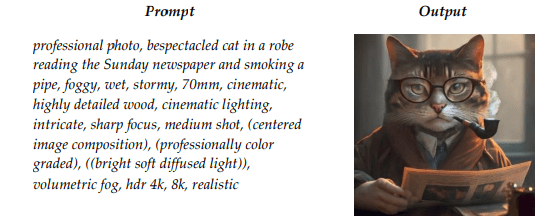
Copyright and Artificial Intelligence, Part 2 Copyrightability Report, Copyright Office at page 19.
The Copyright Office further clarifies that no amount of input revisions will change the fact that the human writing the inputs ultimately lacks sufficient control to have a copyright claim. Merely “‘re-rolling’ the dice, causing the system to generate more outputs from which to select, but not altering the degree of control over the process” is insufficient in the eyes of the Copyright Office for a copyright claim over the output.
Since we know what is not sufficient human authorship, what is? The Copyright Office acknowledges “expressive inputs,” as a use of AI that warrants a copyrightable output. What is an expressive input? They are explained as instances where the human-authored input is reflected in the output (Page 22). The below image, provided by the Copyright Office, illustrates that when the original prompt is clearly perceptible in the output, the original art is copyrightable.
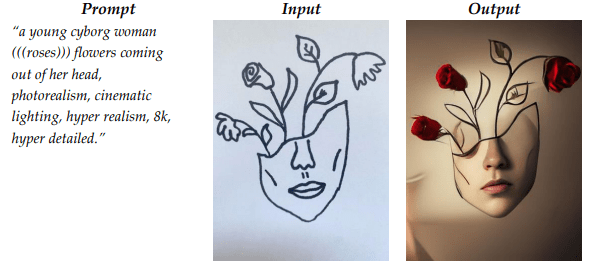
Copyright and Artificial Intelligence, Part 2 Copyrightability Report, Copyright Office at page 23.
Another instance where works that utilize AI can be copyrightable is in the arrangement. According to AI Registration Guidance, “a human may select or arrange AI-generated material in a sufficiently creative way that ‘the resulting work as a whole constitutes an original work of authorship’” (Page 16192). Furthermore, modifying material originally created by AI technology can be protectable, but only the modifications are protectable (Page 16192). While the exact amount of modification is determined on a case-by-case basis, the Copyright Office distinguishes modifications from prompts in that the user has control over selection and placement of individual creative elements (Page 27). Such protection additionally includes the inclusion of AI in a small part of a greater work. The Copyright Office gives the example of special effects used for a specific frame in a film– think an explosion in an action film. While alone, the AI created explosion might not be copyrightable, it is protected as an inclusion to a larger human-authored work (Page 27).
While the world of AI and copyright protection remains new and rapidly evolving, significant progress has already been made. Recent publications by the U.S. Copyright Office provides valuable insight into how AI-assisted creations may be treated moving forward, offering a foundation upon which future legal frameworks and interpretations will continue to develop. As this area of law continues to mature, greater attention to international coordination will be necessary to ensure consistent enforcement and protection across borders.

 IP Law in Context
Leave a comment